



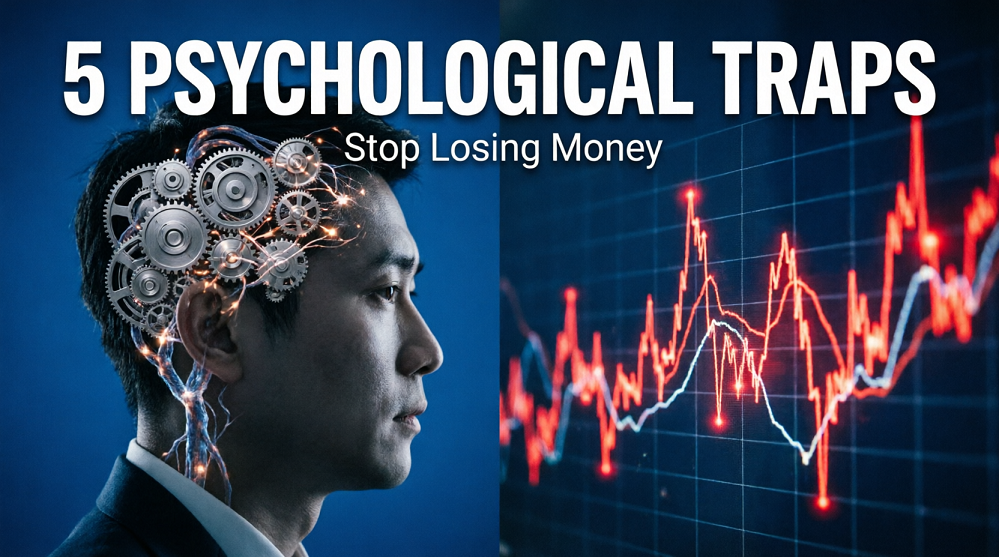
🧠 The Hidden Enemy: Why Your Mind is Your Biggest Risk
You can have the best strategy in the world, the fastest execution, and the lowest spreads. But if your psychology is weak, you will still lose money.
Studies show that 90% of trading failures are due to emotional decisions, not bad strategies. In this article, we reveal the 5 deadly psychological traps that trap even experienced traders and how to escape them.
For more mindset tips, visit the Algo King Blog.
🪤 Trap #1: FOMO (Fear Of Missing Out)
FOMO is the urge to jump into a trade because you see others making money or because the price is moving fast. This leads to:
- Entering at bad prices (chasing the market).
- Ignoring your trading plan.
- Taking unnecessary risks.

Fig 1: FOMO causes traders to make impulsive decisions.
✅ Solution:
Remind yourself: "The market will always be there tomorrow." If you miss a trade, wait for the next setup. Stick to your plan.
😈 Trap #2: Revenge Trading
After a loss, many traders feel angry and want to "win back" their money immediately. They increase lot sizes, ignore stop losses, and take random trades. This usually leads to bigger losses.

Fig 2: Revenge trading is an emotional reaction to losses.
✅ Solution:
If you lose 2-3 trades in a row, stop trading for the day. Take a walk, clear your mind, and come back tomorrow. Never trade when angry.
🤑 Trap #3: Greed & Overtrading
Greed makes traders:
- Hold winning trades too long (hoping for more profit) until they turn into losses.
- Take too many trades in a day (overtrading), leading to fatigue and mistakes.
- Use excessive leverage to "get rich quick."

Fig 3: Greed can turn profits into losses.
✅ Solution:
Set a daily profit target and loss limit. Once you hit either, stop trading. Use trailing stops to lock in profits automatically.
😰 Trap #4: Fear of Pulling the Trigger
Some traders analyze perfectly but hesitate to enter the trade. They fear being wrong. This leads to:
- Missing great setups.
- Entering late (after the move has already happened).
- Self-doubt and lack of confidence.
Fig 4: Hesitation causes missed opportunities.
✅ Solution:
Trust your strategy. Start with small lot sizes to build confidence. Remember: No strategy wins 100% of the time. Losses are part of the game.
🙈 Trap #5: Ignoring Stop Loss
Many traders move or remove their Stop Loss because they "hope" the market will reverse. This is dangerous because:
- One bad trade can wipe out weeks of profits.
- It turns small losses into catastrophic ones.
- It breaks discipline.
Fig 5: Never move your Stop Loss further away.
✅ Solution:
Always use a Stop Loss. Set it before entering the trade and never move it further away. You can only move it closer to lock in profits (trailing stop).
🛡️ How to Build Mental Strength
Overcoming these traps requires practice. Here are 3 daily habits:
- Meditate for 10 minutes: Helps control emotions and improve focus.
- Keep a Trading Journal: Write down your emotions for every trade. Identify patterns.
- Review Weekly: Analyze your journal to see which traps you fall into most often.
For more resources on trading psychology, check out our Help Center.
✅ Final Checklist: Are You Emotionally Ready?
- ☐ Do I have a written trading plan?
- ☐ Am I sticking to my risk management rules?
- ☐ Do I accept losses as part of the business?
- ☐ Am I avoiding revenge trading?
- ☐ Do I review my trades regularly?
🎁 Bonus: Recommended Reading
Want to dive deeper? Explore these topics on our site:
Master Your Mind, Master the Market
Psychology is the key to long-term success.
Frequently Asked Questions
Q: Can I automate my trading to avoid emotions?
A: Yes, using EAs (Expert Advisors) can help remove emotional bias. However, you still need to monitor them.
Q: How long does it take to master trading psychology?
A: It’s a lifelong journey. Most traders see significant improvement after 6-12 months of disciplined practice.
Q: What book do you recommend for trading psychology?
A: "Trading in the Zone" by Mark Douglas is a classic must-read for every trader.
Comments (0)